

AI for the 21st Century
AI and Human Interaction Jargon Free
News
Recent Blog Posts
-
FL vs OpenAI

FL vs OpenAI is the first case brought by a state in the USA against OpenAI seeking to hold the creators of AI accountable. You can read the filing here: State of Florida vs OpenAI. Here’s a summary of the above case. The rise of OpenAI is attributable to a web of deceit and the…
-
AI Power Consumption

AI power consumption is growing at a rapid pace. To put this into perspective, let’s break it down and find out what’s really going on. Power Consumption – USA Currently the US is the undisputed hub for AI, hosting roughly 45% of the worlds data-center capacity. To start us off, let’s look at the breakdown…
-
AI Drinking the World Dry?
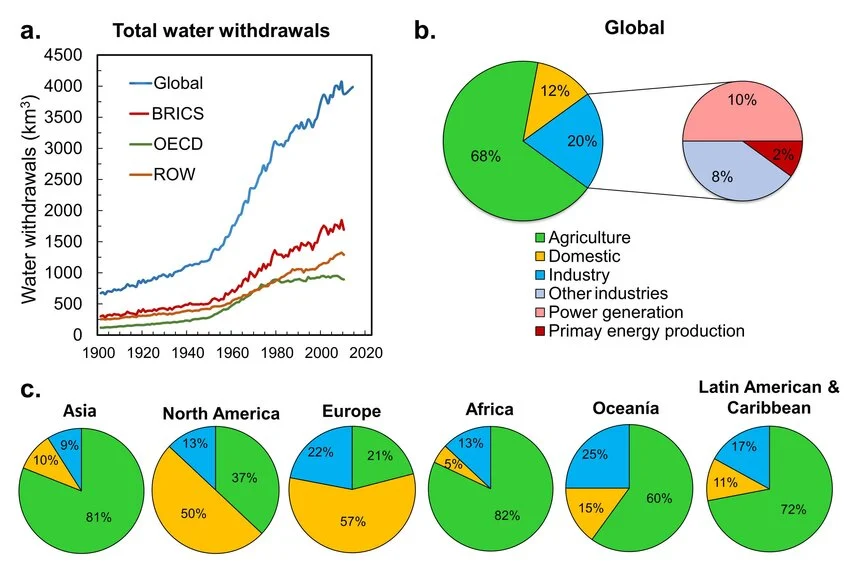
Are AI data-centers drinking the world dry? Short answer is no, they are not. Is the world facing a crisis of available fresh drinking water? The answer here is yes, we are. While AI data-centers are playing there role in the consumption of freshwater, they are also doing something about it. It’s not just data-centers…
-
Machine Learning (ML)

Machine learning is the subset of artificial intelligence (AI) focused on algorithms that can “learn” the patterns of training data and, subsequently, make accurate inferences about new data. This pattern recognition ability enables machine learning models to make decisions or predictions without explicit, hard-coded instructions. Machine Learning Types – Most Common Supervised Involves training models…
-
Checkpoint – May 2026

It’s that time once again for a checkpoint. We’ve covered a lot of ground since our last checkpoint. Let’s dive in and I’ll give you a summary of what we’ve covered. Getting Past the Fear The last month started with an article to get past the fear of AI, titled, AI-Beyond the Fear. From there…
-
Mechanistic Interpretability: What is it and How Did We Get Here?

Mechanistic interpretability and sparse autoencoders will allow us to do something that to date we’ve not been able to accomplish. Debug the hidden layer of AI. Mechanistic interpretability and sparse autoencoders gets us closer to understanding the hidden layer. To get more detail on debugging AI, see my article called Debugging AI. Mechanistic Interpretability: What…
-
Ethical Foundation – AI Logic Layer

Overview of AI Logic Layer The ethical foundation – AI logic layer, provides for the following components. When a request is submitted to the AI, it will flow through the necessary machine learning algorithms and big data integration, processed by the neural network and then feed into our ethics processor. The ethics processor will then…
-
Ethical Foundation – Pillars

Pillars Of Ethical Foundation The pillars of the ethical foundation are supported by the bedrock and contain universal truths/human rights. The intent is to provide a layer common to all of humanity and not a specific countries view. The following pillars provide for the following: Purpose The purpose of the pillars are to guide the…
-
Ethical Foundation – Bedrock

Bedrock Our AI ethical foundation is the bedrock of our architecture. At the root stands our 3 laws of robotics. Elegant laws that are general. Applying the laws to real world scenarios can cloud there elegance. Taken at face value they make a lot of sense. Filtering reality through these laws, we see how quickly…
-
AI Ethical Foundation
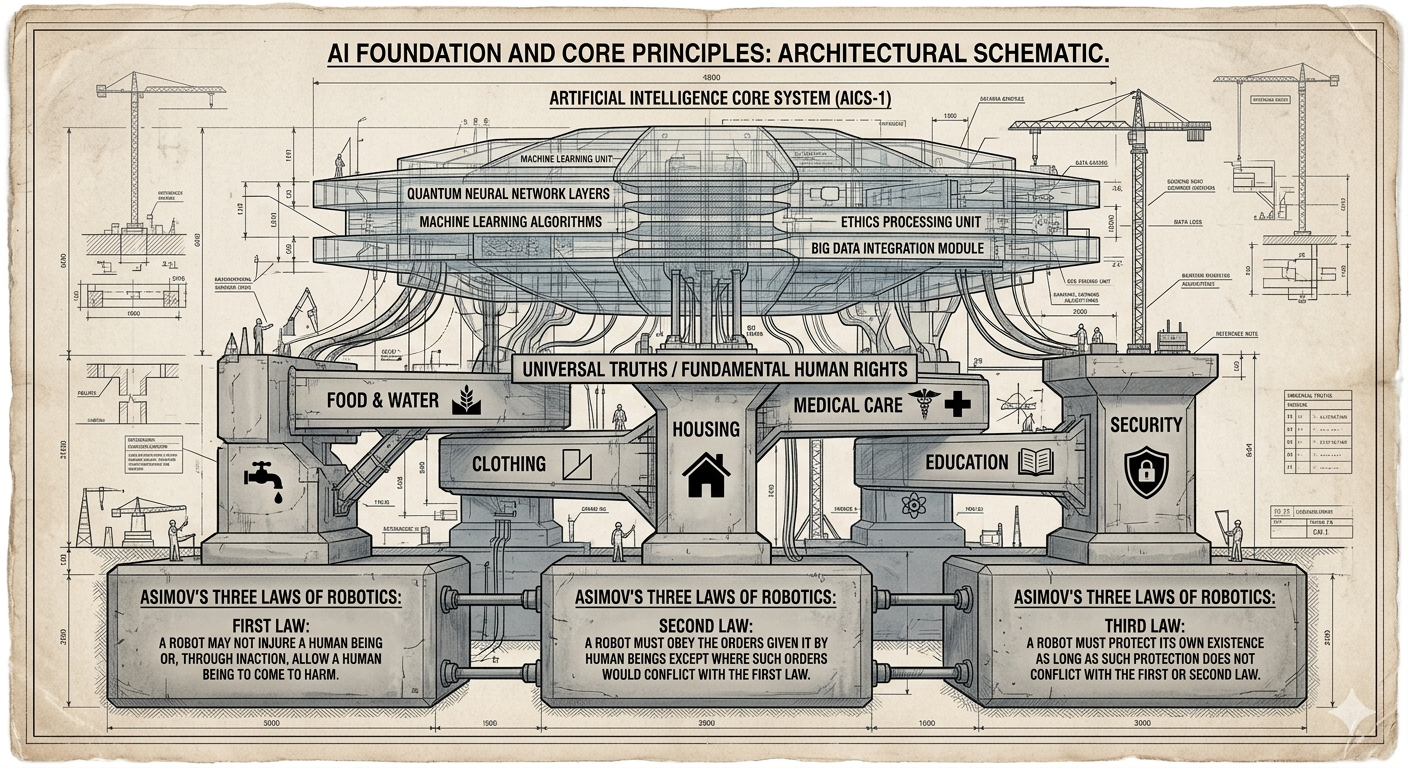
Ethical Foundation – Tier 1 Note: Isaac Asimov penned the original laws below in his 1942 book, Runaround. Scientists like Alan Turing started working with machine intelligence in 1950, AI research ‘officially’ began in 1956. As you see, this is well after Asimov wrote the rules. He envisioned a smart robot. In modern times, robots…